Kawasaki Z400 for Beginners: Power, Handling & Confidence Guide
Learning to ride a motorcycle is one of the most exciting journeys you can take. It’s also filled with questions, a little bit of anxiety, and a lot of choices. One of the biggest decisions you’ll make is choosing your first motorcycle. You need a machine that is forgiving enough to learn on, but capable enough to keep you entertained as your skills grow.
Enter the Kawasaki Z400.
This guide is designed specifically for new riders. We aren’t here to talk about top speeds or knee-dragging track days. Instead, we are going to break down exactly how the Z400 behaves in the real world, how it handles parking lots and city traffic, and why it might just be the perfect partner for your learning curve.
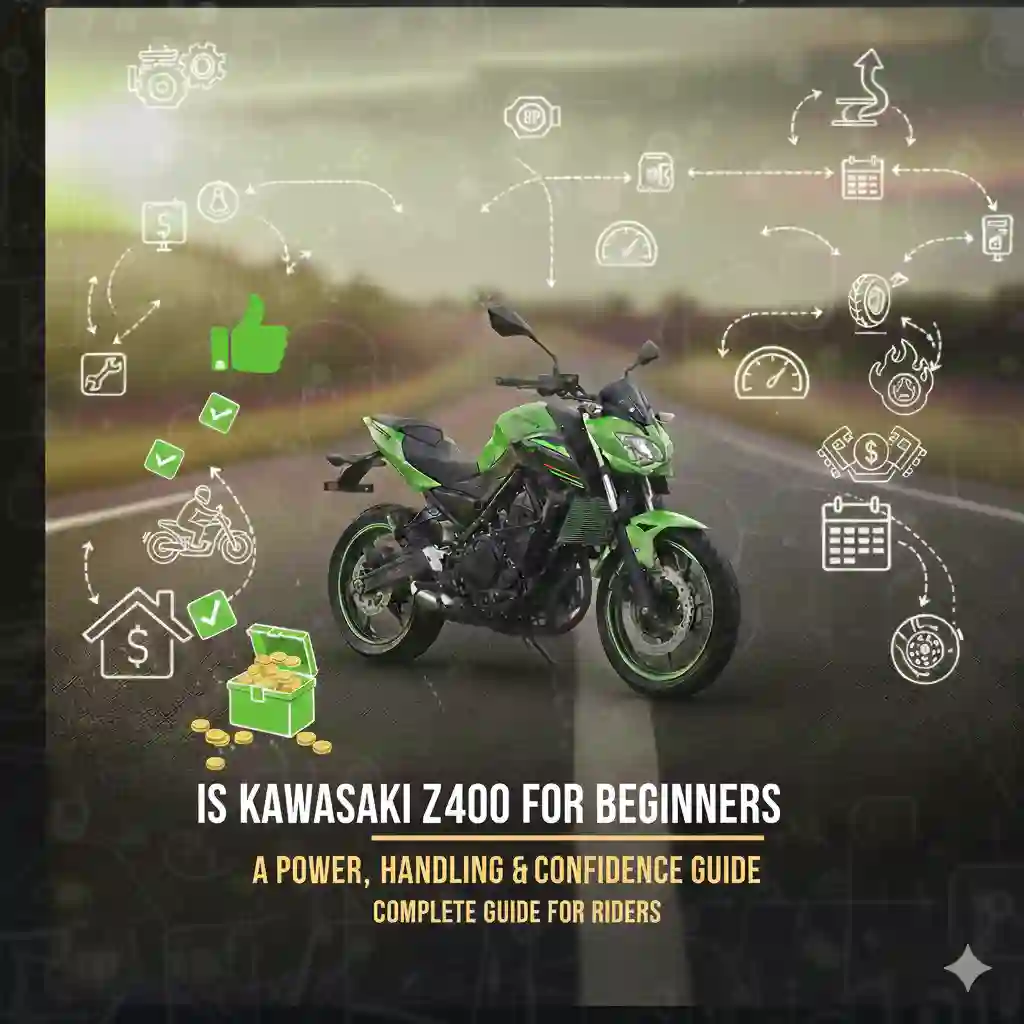
Quick Answer – Can a Beginner Ride a Kawasaki Z400?
Yes, absolutely. The Kawasaki Z400 is widely considered one of the best entry-level motorcycles on the market today. It strikes a near-perfect balance between being approachable for a total novice and offering enough performance to be a solid long-term commuter.
Here is why it works for beginners:
- Lightweight Chassis: It is incredibly easy to balance at slow speeds, reducing the fear of dropping it.
- Manageable Power: The 399cc parallel-twin engine is smooth and predictable. It won’t surprise you with sudden surges of power, but it has enough torque to pull away from traffic safely.
- Forgiving Handling: The bike goes exactly where you look. It doesn’t fight you in corners, making it excellent for learning proper steering techniques.
However, it is slightly more powerful than the 300cc bikes of the past. It requires respect and a gradual approach to learning throttle control. If you treat it with patience, it is a fantastic tool for building rider confidence.
Why the Z400 Appeals to Beginners
The Z400 sits in a “Goldilocks” zone of the beginner market. For years, 250cc or 300cc bikes were the standard. While excellent for learning, many riders outgrew them within a few months. On the other end, 650cc bikes can sometimes feel heavy and intimidating for a brand-new rider.
The Z400 bridges this gap. It is a naked bike, meaning it lacks the heavy plastic fairings of sportbikes. This strips away unnecessary weight and gives it a raw, mechanical look. But beyond aesthetics, the naked design usually means a more upright, commanding riding position—crucial for seeing over traffic and feeling in control.
It offers a learning platform that grows with you. In your first month, you will appreciate how light the clutch is and how easy it is to park. By your sixth month, you will appreciate that it has enough power to merge onto the highway without feeling like the engine is going to explode. It is a transition bike that doesn’t feel like a toy.
Ergonomics & Rider Fit
Confidence starts with comfort. If you are struggling to reach the controls or feel stretched out, you cannot focus on the road. Kawasaki designed the Z400 with a wide range of body types in mind.
Seat Height and Reach
The seat height is approachable for most riders, sitting at approximately 30.9 inches (785 mm).
- For Shorter Riders: This low height allows many riders to get both feet flat on the ground, or at least the balls of both feet. Being able to “flat-foot” a bike at a stoplight provides a massive psychological safety net when you are learning.
- For Taller Riders: While compact, the tank shape allows your knees to tuck in comfortably. Very tall riders (over 6’2″) might feel a bit cramped on long rides, but for learning purposes, it remains manageable.
Upright Riding Position
Unlike a sportbike that forces you to hunch over the tank, the Z400 puts you in a neutral, upright posture. Your back is relatively straight, and your arms have a slight bend as they reach the wide handlebars.
- Better Vision: Being upright helps you scan the horizon and check blind spots easily.
- Better Balance: It is easier to balance your body weight when your spine is vertical.
- Less Fatigue: There is very little weight on your wrists, meaning you can ride longer without discomfort.
Control Layout
The footpegs are positioned directly beneath you, not too far back or forward. This allows you to stand up slightly to absorb bumps—a key skill for city riding. The handlebars are wide enough to provide plenty of leverage, making steering feel light and responsive without needing muscle.
Power Delivery & Engine Handling
The heart of the Z400 is a 399cc liquid-cooled parallel-twin engine. For a beginner, “parallel-twin” is a great term to hear. It generally means the engine is compact, narrow, and offers a good balance of low-end grunt and high-end smoothness.
Smooth Throttle Response
One of the biggest fears for new riders is “whiskey throttle”—accidentally twisting the grip too much and losing control. The Z400 has a very linear power delivery. When you twist the throttle a little, you get a little acceleration. It doesn’t have a terrifying “power band” that kicks in unexpectedly.
Torque for City Traffic
Torque is the force that gets you moving. The Z400 has excellent low-end torque. This means the bike pulls away from a stop sign easily without needing to rev the engine high. This reduces the likelihood of stalling, which is the number one anxiety for new riders at intersections.
Highway Capability
While it is a beginner-friendly engine, it is not slow. It can easily reach and maintain highway speeds. However, the power is delivered in a way that feels “busy” but controllable. You will feel the engine working, but it won’t feel uncontrollable. This gradual exposure to speed helps you acclimatize to the sensation of riding faster without being overwhelmed.
Low-Speed & Maneuvering Skills
Most drops happen at speeds below 5 mph. Parking lots, U-turns, and garage driveways are where beginners struggle most. The Z400 shines in this environment because of its lightweight motorcycle design (curb weight is around 364 lbs).
Parking Lot Practice
Because the bike is light, practicing low-speed drills is less tiring. You can spend an hour in a parking lot practicing figure-eights and emergency stops without feeling like you’ve been wrestling a bear. If the bike starts to tip slightly, it is light enough that most riders can easily correct it with a firm plant of the foot.
The Friction Zone
The Z400 features a “Assist and Slipper” clutch. In plain English, this means the clutch lever is incredibly light to pull. You can hold it in with one or two fingers comfortably. This is vital for learning the “friction zone”—the point where the clutch engages and the bike starts to move. A light clutch allows you to finesse this zone with precision, making slow-speed crawling in traffic much smoother.
Turning Radius
The steering lock (how far the handlebars turn left and right) is generous. This gives the Z400 a tight turning radius, making U-turns on narrow streets much less stressful. You won’t feel like you need a three-point turn to get out of a parking space.
Braking & Safety Features
Stopping is more important than going. As a beginner, you need brakes that are effective but not “grabby.”
ABS Explained
The Z400 comes equipped with Anti-lock Braking System (ABS) as standard in many markets (always check the specific model you are buying). ABS is a critical safety net for new riders.
- What it does: If you panic and grab the brake lever too hard, the wheels might lock up, causing a skid. ABS detects this instantly and pulses the brakes faster than a human could, preventing the skid and allowing you to maintain steering control.
- Why it matters: It turns a potential crash into a controlled stop. Knowing you have ABS gives you the confidence to practice braking firmly without the fear of the front wheel washing out.
Brake Feel
The brakes on the Z400 are progressive. The initial bite (when you first touch the lever) is soft, preventing the bike from diving aggressively if you are a bit clumsy. As you squeeze harder, the stopping power builds linearly. This teaches you to modulate your braking pressure—a key skill for intermediate riding.
Tire Grip
The stock tires provide adequate grip for learning. They are designed for longevity and all-weather use rather than racetrack performance. For a beginner, this is ideal. They warm up relatively quickly and provide decent feedback in wet conditions, helping you learn to trust your traction.
Riding in Traffic – City & Suburban Tips
The Z400 is arguably one of the best city commuters you can buy. Its slim profile and agility make it perfect for navigating the chaos of urban environments.
Stop-and-Go Strategy
In heavy traffic, you are constantly shifting between first and second gear. The Z400’s gearbox is slick and neutral is easy to find (usually), reducing frustration at red lights. The light clutch saves your left hand from cramping during rush hour.
Lane Positioning
Because the bike is narrow, you have plenty of room within your lane to adjust your position. This allows you to move away from blind spots and set up for turns effectively. The upright seating position lets you see over the roofs of sedans, giving you a few extra seconds to react to brake lights ahead.
Handling Intersections
Intersections are high-risk zones. The Z400’s quick acceleration allows you to move away from a pack of cars when the light turns green, creating a safety buffer. Its agile steering allows you to swerve around potholes or debris quickly and safely.
Highway & Short Trips for Beginners
Eventually, you will want to leave the city. Taking a naked bike onto the highway is a different experience than driving a car.
Wind Exposure
Because the Z400 has minimal wind protection (no large windscreen), you will feel the wind on your chest and helmet.
- The Learning Moment: At 65 mph, this wind blast can be tiring at first. It teaches you to relax your grip on the handlebars. If you hold on tight to fight the wind, you will unsettle the bike. The Z400 teaches you to lean into the wind slightly and use your core muscles.
- Short Trips First: Start with short highway hops (1-2 exits). Get used to the sensation of speed and wind before attempting a long road trip.
Stability at Speed
Despite being light, the Z400 feels planted. It has a wheelbase long enough to provide stability but short enough to remain agile. You won’t feel like you are being blown across the lane by every passing semi-truck, though you will feel some buffeting.
Passing Power
The 399cc engine has enough reserve power to pass vehicles at highway speeds. You might need to downshift from 6th to 5th gear to get a quick burst of acceleration, but the bike is capable. This teaches you gear management and planning your overtakes—essential skills for any rider.
Skill Progression – From Beginner to Confident Rider
The Z400 is not a bike you just learn on; it is a bike you learn with.
Month 1: The Basics
Focus on clutch control, smooth stops, and low-speed balance. Keep your rides short and in familiar areas. The Z400’s friendly nature will help you overcome the initial nerves.
Month 3: Building Flow
Start connecting corners smoothly. The Z400 responds beautifully to counter-steering. You will start to feel how the bike leans and how stable it feels on its side. You can begin to explore slightly higher RPMs, feeling the engine come alive.
Month 6: Advanced Control
By now, you should be comfortable with rev-matching (blipping the throttle on downshifts) and trail braking (braking slightly into a corner). The Z400 is capable enough to practice these advanced techniques. It has enough performance to keep you entertained, meaning you won’t feel the desperate need to “upgrade” immediately.
Maintenance Awareness for Beginners
Part of being a rider is taking care of your machine. The Z400 is reliable, but it needs love. Building a pre-ride routine is a safety habit that will last a lifetime.
T-CLOCS Inspection
Before every ride, do a quick check:
- Tires: Check for pressure and cuts. Low pressure ruins handling.
- Controls: Ensure levers and pedals work smoothly.
- Lights: Check turn signals and brake lights.
- Oil: Check the sight glass to ensure oil levels are correct.
- Chassis: Look for loose bolts.
- Stand: Ensure the kickstand works properly.
Chain Maintenance
The Z400 has a chain drive. You will need to clean and lube it every 500-600 miles. It’s a messy job, but it helps you get to know your bike. A well-maintained chain ensures smooth power delivery and safety.
Common Beginner Mistakes & How to Avoid Them
Even on a forgiving bike like the Z400, mistakes happen. Here is how the bike helps you handle them.
Stalling
- Mistake: Letting the clutch out too fast without enough throttle.
- The Fix: The Z400 has good low-end torque. Practice finding the friction zone in a parking lot until it’s muscle memory.
Target Fixation
- Mistake: Staring at the pothole or curb you are trying to avoid, and then driving right into it.
- The Fix: The Z400 steers where you look. Force your head to turn and look toward your exit path. The bike handles so lightly that it will follow your eyes almost instantly.
Tensing Up
- Mistake: Gripping the bars with a “death grip” when nervous. This makes the steering twitchy and the ride harsh.
- The Fix: Flap your elbows like a chicken occasionally. If you can’t, you are too tight. The Z400’s upright ergonomics make it easy to maintain a relaxed upper body.
FAQs – Beginner-Focused
Can a total beginner ride the Z400 safely?
Yes. If you have taken a basic safety course (like the MSF in the USA), the Z400 is a perfect first street bike. It is forgiving but capable.
How long does it take to get used to the Z400?
Most riders feel comfortable with the weight and balance within a few hours of practice. Mastering traffic and higher speeds usually takes a few weeks of consistent riding.
Is the seat height comfortable for short riders?
Generally, yes. At 30.9 inches, it is one of the more accessible bikes in its class. Additionally, the seat is narrow at the front, which helps your legs reach the ground more easily.
How do I avoid stalling at stoplights?
Practice holding the clutch in the “friction zone” for 2-3 seconds as you start moving. Don’t just dump the lever. Give it a tiny bit of throttle as you ease the clutch out.
Can the Z400 teach me to ride confidently on highways?
Yes. It is stable enough for highway use. Start with short trips during off-peak hours to get used to the wind and speed without the pressure of heavy traffic.
Is the Z400 expensive to insure for a new rider?
Usually, no. Because it is a smaller displacement engine (under 400cc), insurance premiums are typically much lower than for 600cc or 1000cc sportbikes.
Does it have enough power for two people?
It can carry a passenger for short trips around town, but the extra weight will make the bike feel sluggish and harder to balance. It is best to learn solo for at least a year before adding a passenger.
What gear should I wear on a Z400?
Always wear a full-face helmet, jacket, gloves, riding pants, and boots. “All the gear, all the time” (ATGATT). The Z400 is a real motorcycle capable of real speeds; dress for the slide, not the ride.
Final Verdict – Beginner Specialist Perspective
The Kawasaki Z400 is more than just a starter bike; it is a confidence-building machine. It removes the intimidation factor of motorcycling—the heavy weight, the aggressive posture, the scary power—and leaves you with the pure fun of riding.
It is approachable enough that you won’t be scared to take it out of the garage, but engaging enough that you’ll look for excuses to ride it to the grocery store. It encourages safe skill progression. You can learn to brake properly, corner smoothly, and navigate traffic without fighting the machine.
If you are looking for a first motorcycle that will welcome you into the sport with open arms and teach you the fundamentals of riding safely, the Z400 is an outstanding choice. It’s reliable, it’s fun, and most importantly, it’s on your team.


