Honda CB300R Pros & Cons: An Honest Review
Deciding on a motorcycle, especially your first one, is more of an emotional choice than a logical one. You’re not just buying a machine; you’re buying into an experience, a lifestyle, and a new set of skills. The Honda CB300R is a bike that frequently appears on “best beginner” lists, but is it truly worth your money? The answer depends entirely on who you are and what you want from riding.
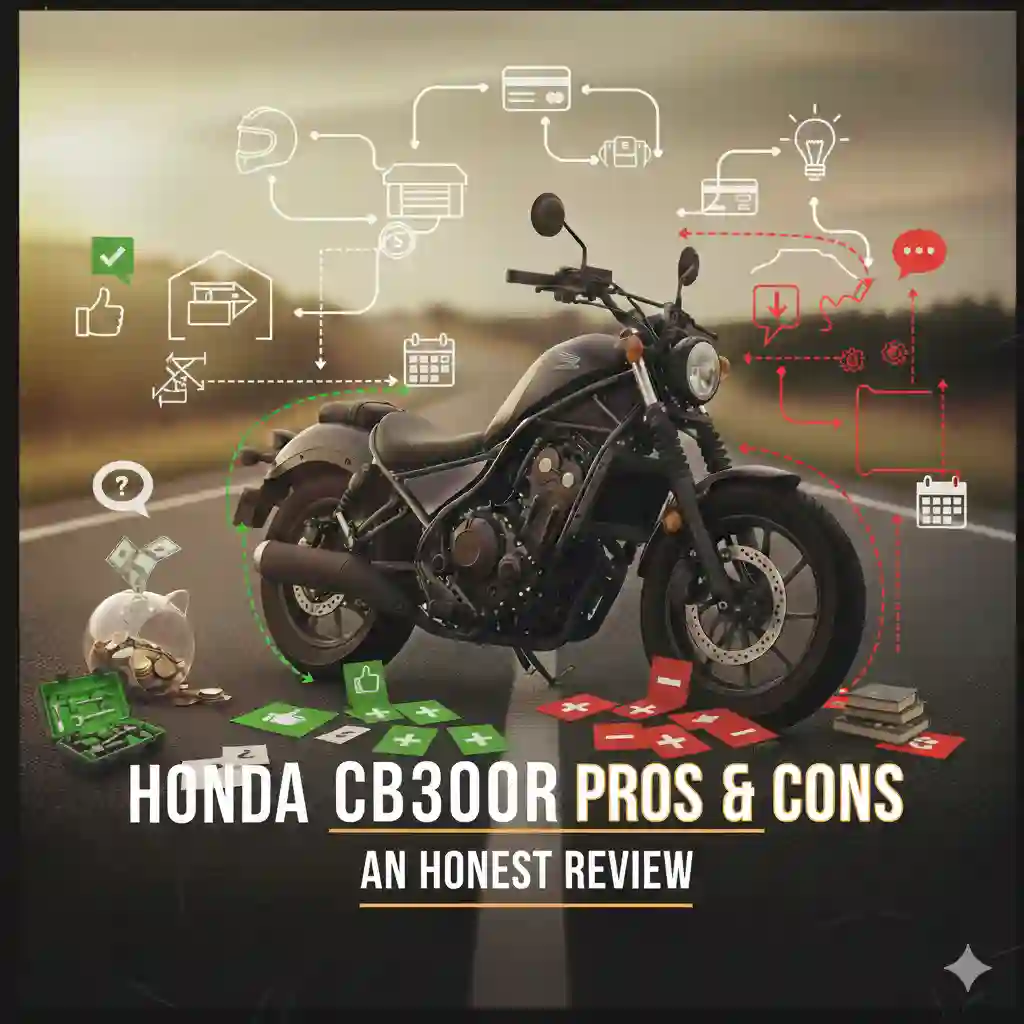
This guide provides a balanced, honest breakdown of the Honda CB300R’s pros and cons. We will move beyond the spec sheet to explore the real-world ownership experience, helping you decide if this bike aligns with your goals and preventing the dreaded buyer’s remorse. This is the frank conversation you need before you make a decision.
Quick Verdict: Is the Honda CB300R Worth It?
For the right person, the Honda CB300R is absolutely worth it. It is one of the most intelligent and low-stress purchases a new rider can make.
- Yes, it’s worth it if: You are a new rider focused on learning, a city commuter who needs an agile and economical vehicle, or an experienced rider downsizing to a simpler machine. Its value lies in its ease of use, low ownership stress, and a confidence-building nature that is second to none.
- Maybe, if: You are unsure about your long-term riding goals or have a mix of city and occasional highway commuting. You will appreciate its city manners but may feel its limitations on the open road.
- No, it is not worth it if: Your primary goal is high-speed highway travel, two-up touring, or the adrenaline rush of raw power. The CB300R is not designed for these purposes, and you will be frustrated by its limitations.
What “Worth It” Actually Means for Motorcycles
Before we dive into a list of pros and cons, we need to reframe what “value” means in motorcycling. A bike’s worth is not determined by its 0-60 time or its horsepower figure. True value is a combination of factors that contribute to your overall enjoyment and safety.
- Confidence and Control: Is the bike easy to manage? Does it make you feel in command or intimidated? A bike that builds your confidence is priceless.
- Comfort and Usability: Do you enjoy sitting on it? Is it practical for your daily life? An uncomfortable bike, no matter how fast, will just sit in the garage.
- Ownership Stress: How reliable is it? Are parts expensive? Is it a hassle to maintain? A low-stress bike lets you focus on riding, not wrenching.
- Purpose Alignment: Does the bike do the job you are hiring it for? A sport bike is a poor choice for a dirt road, and a touring bike is clumsy in city traffic. “Worth it” means the bike matches your lifestyle.
The Honda CB300R’s value proposition is heavily weighted toward confidence, usability, and low ownership stress.
Honda CB300R Pros (Explained with Context)
The advantages of the CB300R are significant, especially for its target audience.
Pro: Incredibly Lightweight and Easy Handling
This is the CB300R’s defining characteristic. At around 317 lbs, it is featherlight.
- Why it matters: This low weight makes the bike feel like an extension of your body. At low speeds, like in a parking lot, it is effortless to maneuver. For a beginner worried about dropping their first bike, this is a massive confidence booster. In traffic, it allows you to change direction with surgical precision. This lightweight chassis is the core of the bike’s friendly personality.
Pro: Beginner-Friendly Power Delivery
The 286cc single-cylinder engine is designed to be predictable, not explosive.
- Why it matters: The throttle response is smooth and linear. This means no surprise power surges that can catch a new rider off guard. You learn how to manage power in a controlled environment. It has enough punch to be fun and get ahead of city traffic, but not enough to be terrifying. This forgiving nature is crucial for building a solid foundation of throttle and clutch control.
Pro: Comfortable, Upright Riding Position
Unlike aggressive sport bikes that fold the rider in half, the CB300R offers a natural, upright posture.
- Why it matters: This riding comfort is key for commuters and learners. It reduces strain on your wrists, back, and neck. More importantly, it gives you a commanding view of the road, allowing you to scan for hazards more effectively—a critical skill for urban survival.
Pro: Low Mental Fatigue in Traffic
Riding is a mental exercise, especially for beginners. The CB300R is designed to reduce your mental workload.
- Why it matters: The light clutch pull, easy handling, and predictable engine mean you spend less brainpower managing the machine and more on navigating your environment. This is safer and makes the entire riding experience more enjoyable and less stressful.
Pro: Legendary Honda Reliability
Honda’s reputation for building durable, reliable engines is well-earned, and the CB300R is a prime example.
- Why it matters: This is a bike you can depend on. It starts every time. It requires minimal unscheduled maintenance. For a new rider, this peace of mind is invaluable. It removes the anxiety of being stranded and lets you focus on the joy of riding.
Pro: Low Ownership Stress (Costs & Maintenance)
The CB300R is one of the most economical motorcycles to own and operate.
- Why it matters: It achieves excellent fuel efficiency, which saves you money on every trip. Insurance premiums are typically very low. The simple single-cylinder engine is inexpensive to service. This low financial barrier makes motorcycling more accessible and reduces the stress of ownership.
Honda CB300R Cons (Honest, Not Dramatic)
No bike is perfect. The CB300R’s disadvantages stem directly from the design choices that make it so good in other areas.
Con: Limited Highway Comfort
While it can handle highway speeds, it is not a comfortable place to be for long.
- Who it affects: Riders with long highway commutes or those who dream of cross-country tours. The combination of engine vibrations at high RPMs and a complete lack of wind protection leads to significant rider fatigue. It’s fine for short hops, but it’s the wrong tool for sustained highway travel.
Con: The Nature of a Single-Cylinder Engine
The engine that provides punchy, fun low-end torque for the city has a different character at high speed.
- Who it affects: Riders who are sensitive to vibrations or who spend a lot of time near the top of the rev range. “Singles” naturally vibrate more than twin-cylinder engines. While the CB300R is well-balanced, it is not as glassy-smooth as a Yamaha MT-03 at 70 mph.
Con: You May Outgrow the Power
This is the most common reason people sell their CB300R.
- Who it affects: Almost every rider who continues to develop their skills. The CB300R is an amazing teacher, but once you graduate, you may find yourself wanting more acceleration for passing cars on two-lane roads or for the thrill of it. This isn’t a failure of the bike; it’s a success of its teaching.
Con: Not Ideal for Two-Up Riding
The CB300R is a solo machine at heart.
- Who it affects: Riders who plan to carry a passenger frequently. The passenger seat is small, and the bike’s lightweight nature means that adding a second person has a noticeable impact on acceleration, braking, and handling. It’s okay for a quick trip across town, but not for a weekend ride.
Pros vs Cons in Real-World Scenarios
Let’s apply this analysis to common riding situations.
- For Daily Commuting: The pros overwhelmingly outweigh the cons. Its light weight, nimble handling, and excellent fuel economy make it a nearly perfect urban tool. The highway limitations are irrelevant if your commute is on city streets.
- For Weekend Riding: It depends on the type of weekend ride. For exploring tight, twisty back roads, the CB300R is a blast. Its lightweight nature lets you carry more speed through corners. For long, sweeping country roads with high speeds, you might wish for more power and wind protection.
- For the Beginner Learning Phase: The pros are dominant. The forgiving power, low weight, and safe brakes create the ideal environment for mastering core skills with minimal stress.
- For Long-Term Ownership: If you live in a dense city and only ride within its limits, you may never need another bike. If your riding ambitions expand to include touring or track days, you will likely see it as a stepping stone.
Is the CB300R Worth It as a First Motorcycle?
Yes, for the reasons outlined above, it is one of the best first motorcycles on the market. Its design philosophy directly addresses the biggest fears and challenges that new riders face.
The main reason a beginner might be disappointed is if they buy it with the wrong expectations. If you buy a CB300R hoping it will feel like a 1000cc superbike, you will be let down. But if you buy it as a tool to learn on, a machine to build confidence with, and a partner for urban exploration, you will feel like you made the smartest decision possible. For a full deep-dive, see our Honda CB300R Beginner Guide.
Is the CB300R Worth It Long-Term?
For most riders, the CB300R is not a “forever bike.” The typical ownership cycle is between one and three years. During this time, a rider’s skills and confidence grow to a point where they are ready for more performance.
This is a good thing. The CB300R has excellent resale value precisely because it is such a sought-after starter bike. You can ride it for a couple of years, master your skills, and sell it for a good price to the next beginner in line. Think of it as a low-cost, high-value apprenticeship in motorcycling.
The exception is the dedicated city rider who may keep it indefinitely as a nimble, practical second bike.
CB300R vs Alternatives: Value Comparison
How does the CB300R’s “worth” stack up against its competitors?
- vs. Yamaha MT-03: The MT-03 offers better highway performance due to its smoother twin-cylinder engine. The CB300R offers a lighter, more nimble city experience and arguably a more premium fit and finish.
- vs. Kawasaki Ninja 400: The Ninja 400 offers significantly more power and better wind protection, making it a more capable all-arounder. The CB300R offers a gentler learning curve and lower insurance costs.
- vs. KTM 390 Duke: The Duke offers more power and technology. The CB300R offers superior reliability and lower ownership stress. It’s a choice between performance and peace of mind.
- vs. Honda Rebel 300/500: The Rebel offers a lower seat height and cruiser styling. The CB300R provides more standard ergonomics that teach skills applicable to a wider range of future motorcycles.
When the CB300R Is the Wrong Choice
Being an informed buyer means knowing when to say no. You should look for a different motorcycle if:
- Your daily commute is more than 20 minutes on a high-speed freeway.
- You plan on carrying a passenger for more than just occasional short trips.
- Your primary motivation for riding is the feeling of powerful acceleration.
- You want one bike to serve all your needs for the next five-plus years, including touring.
Acknowledging this isn’t a knock on the bike; it’s about respecting its specialized design.
Owner Regret: What People Wish They Knew
Looking through owner forums reveals a few common themes.
- Most Common Regret: Riders who sell it often say, “I wish I had kept it as a second bike.” They miss its simplicity and ease of use for quick errands.
- Most Common Positive Surprise: Many owners are surprised by how “capable” it feels despite its small engine. They praise its ability to be fun and engaging on twisty roads.
- The Expectation Gap: The happiest owners are those who went in knowing its limitations. The most disappointed are those who expected it to be a do-it-all machine. Your satisfaction will be directly proportional to the realism of your expectations.
FAQs: Pros, Cons & Value
1. Is the Honda CB300R underpowered?
For city riding, no. It is perfectly powered. for highway riding, it can feel underpowered when trying to make quick passes at high speed.
2. Will I get bored of the CB300R after a year?
You might get bored of the power level, but you will likely never get bored of how easy and fun it is to handle.
3. Does the CB300R feel cheap?
No. This is one of its biggest pros. The fit, finish, and components (like the suspension and brakes) feel more premium than many of its competitors.
4. Is it worth buying a used CB300R?
Absolutely. A well-maintained used model is one of the best values in motorcycling, as you avoid the initial depreciation hit.
5. Is the CB300R better than a sport bike for beginners?
For most beginners, yes. The upright ergonomics and focus on control make it a better learning environment than an aggressive sport bike like the Ninja 400.
6. What is the biggest advantage of the CB300R?
Its incredibly low weight, which translates directly into confidence and ease of handling.
7. What is its biggest disadvantage?
Its lack of highway comfort due to engine character and no wind protection.
8. How reliable is the CB300R really?
It is exceptionally reliable. It is a modern Honda, and a failure to start or a mechanical breakdown is extremely rare with proper maintenance.
9. Is it a good value for the money?
Yes. Between its reasonable purchase price, low running costs, and strong resale value, it represents excellent financial value.
10. Why choose the CB300R over the more powerful KTM 390 Duke?
Choose the CB300R if you prioritize reliability, a calmer learning curve, and lower long-term ownership stress.
11. Is the wind on the highway really that bad?
It is not “bad” in a dangerous way, but it is physically tiring. It feels like a constant, strong push against your body.
12. Can you modify the CB300R to be faster?
You can add an exhaust and tune the engine for a small performance gain, but it is not cost-effective. If you want more power, it is better to sell the 300 and buy a larger bike.
Final Verdict: Motorcycle Specialist Perspective
The Honda CB300R is a motorcycle that is refreshingly honest. It knows exactly what it is: a confidence-building tool for new riders and a master of the urban environment. Its worth is not found on a dyno chart but in the quiet confidence it instills in its rider on a daily basis.
It is not designed to impress your friends with its speed. It is designed to make you a better, safer, and more skilled rider. For this purpose, it is nearly flawless. If you are starting your journey on two wheels and your priority is to learn well, have fun, and minimize stress, the Honda CB300R is one of the safest and most enthusiastic recommendations a motorcycle specialist can make.


