Yamaha MT-03 vs Competitors – Ninja 400, Duke 390, CB300R & R3 Compared
Choosing your first motorcycle—or your next lightweight street bike—is rarely a straight line. You start with one model in mind, but the moment you open a browser tab, you are bombarded with options. The entry-level market is currently in a golden age, with manufacturers pouring serious engineering into the 300cc–400cc class.
The Yamaha MT-03 sits squarely in the middle of this competitive storm. It promises a “Dark Side of Japan” attitude with manageable performance. But is it the right choice when stacked against the aggressive Kawasaki Ninja 400, the wild KTM 390 Duke, the ultra-light Honda CB300R, or its own sibling, the Yamaha R3?
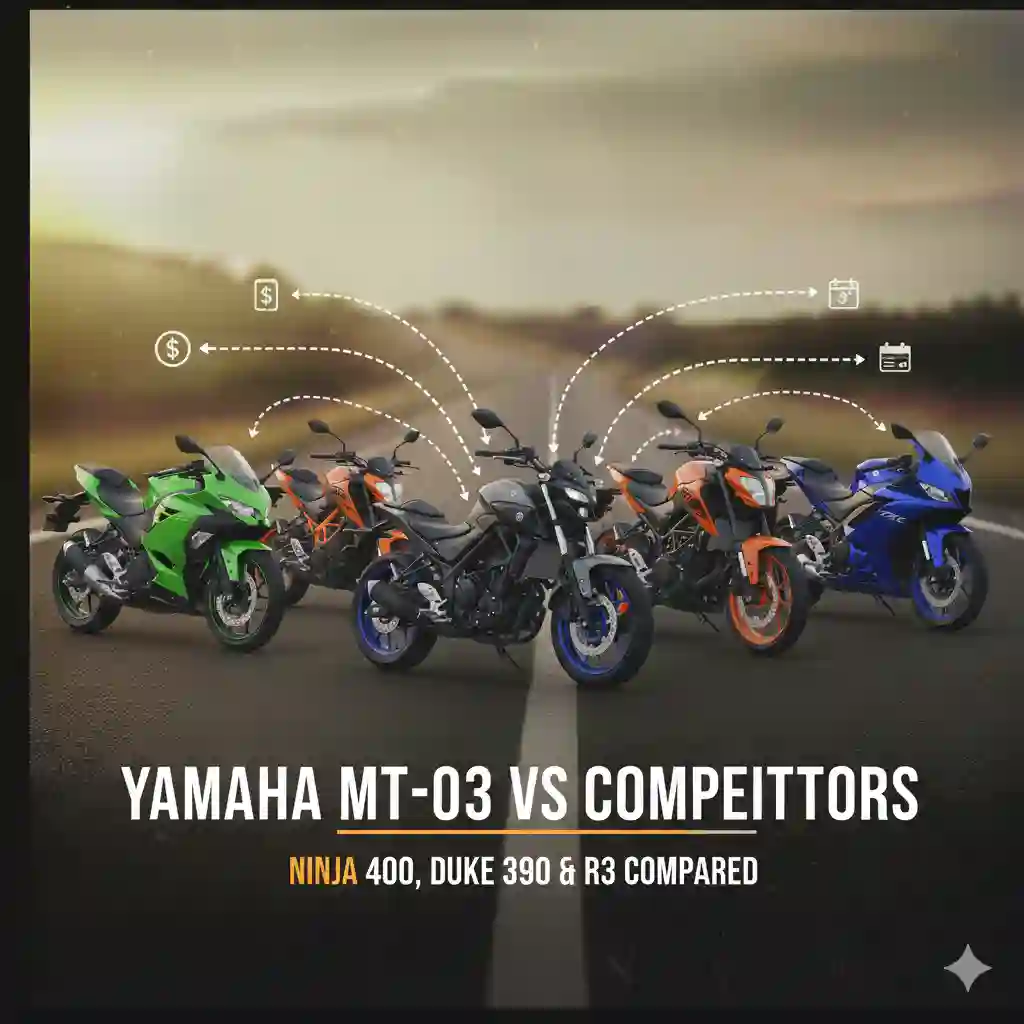
This guide strips away the marketing hype to provide a neutral, logical comparison. We aren’t here to declare a single winner because the “best” bike depends entirely on who is riding it. Instead, we will break down the differences in engine character, ergonomics, and ownership reality to help you decide which machine fits your life.
Quick Overview – Which Bike Is Right for You?
If you are skimming for a quick answer, here is the high-level breakdown of how these bikes position themselves in the market.
- Choose the Yamaha MT-03 if: You want a balanced, reliable urban street bike with modern naked styling. It excels as a “do-it-all” city machine that is comfortable, approachable, and fun without being extreme in any one category.
- Choose the Kawasaki Ninja 400 if: You want class-leading power and highway capability. It feels more substantial and offers wind protection, making it the better choice for riders who plan on longer commutes or faster backroad riding.
- Choose the KTM 390 Duke if: You want adrenaline and technology. It is the sharpest, punchiest, and most aggressive bike in the class, but it demands more from the rider and can be more expensive to maintain.
- Choose the Honda CB300R if: You prioritize lightweight simplicity and style. It is significantly lighter than the others, making it the easiest to handle in tight city traffic, though it lacks the highway power of the twin-cylinder bikes.
- Choose the Yamaha R3 if: You love the MT-03 engine but want the sportbike look and aerodynamics. It shares the same heart as the MT-03 but wraps it in full fairings for better high-speed stability and wind protection.
Yamaha MT-03 vs Kawasaki Ninja 400
The battle between Yamaha and Kawasaki in the lightweight class is legendary. While the Ninja 400 (and the newer Ninja 500) often gets the spotlight for its displacement advantage, the MT-03 offers a different value proposition.
Engine Character: Twin vs. Twin
Both motorcycles utilize a parallel-twin engine, which is the gold standard for this class. However, the Ninja 400 has a displacement advantage (399cc vs 321cc).
- Ninja 400: Feels stronger everywhere, particularly at highway speeds. You don’t have to downshift as often to pass cars. It pulls harder from the midrange.
- MT-03: Feels smoother and rev-happy. While it gives up some torque to the Kawasaki, the Yamaha engine is incredibly refined. It encourages you to rev it high, making it feel sporty and engaging in the city, even if it’s technically slower in a drag race.
Riding Position
This is the biggest differentiator.
- MT-03: Features a true “naked” upright position with wide handlebars. You sit in the bike with your back relatively straight. This offers superior leverage for low-speed maneuvers and U-turns.
- Ninja 400: While it is a “sport” bike, it has relatively relaxed clip-on handlebars compared to a supersport (like a ZX-6R). However, you are still leaned forward more than on the MT-03. Over a long city commute, the MT-03 puts less strain on your wrists.
Beginner Confidence
For a nervous beginner, the MT-03 often feels less intimidating. The wide bars give a sense of control that clip-ons don’t. The lack of fairings also means there is less expensive plastic to break if the bike tips over in a parking lot—a common fear for new riders.
Insurance & Ownership
Both bikes are very affordable to own. However, in some regions, insurance companies classify the Ninja 400 as a “sport” bike, leading to slightly higher premiums compared to the “standard” classification of the MT-03. Parts availability for both is excellent.
Final Decision Logic
If your riding involves 70% city streets and 30% highway, the MT-03 is likely the more comfortable and practical daily rider. If your mix is 50/50 or heavy on highway miles, the Ninja 400‘s extra power and wind protection make it the superior tool.
Yamaha MT-03 vs KTM 390 Duke
The KTM 390 Duke is often called the “Corner Rocket.” It brings a completely different philosophy to the table compared to the Japanese reliability of the Yamaha.
Engine Feel: Smoothness vs. Punch
This is a clash of engine architectures.
- MT-03 (Parallel Twin): Smooth, linear, and predictable. It builds power gradually. It is easy to ride slowly and easy to ride fast.
- Duke 390 (Single Cylinder): Raw, punchy, and aggressive. Single-cylinder engines deliver torque instantly. The Duke wants to wheelie; it wants to go. However, at highway speeds or low RPMs, it vibrates significantly more than the smooth Yamaha.
Throttle Response
- MT-03: The throttle is forgiving. A small twitch of the wrist doesn’t result in a jerky reaction from the bike. This makes it easier for beginners to learn smooth control.
- Duke 390: The throttle is “snatchy” and sensitive, especially in lower gears. While experienced riders love this instant response, it can be jerky and unnerving for a new rider trying to navigate a slow roundabout.
Tech & Features
The KTM wins on spec-sheet features. It typically comes with a TFT display, Bluetooth connectivity, and advanced ABS modes (like “Supermoto mode” to slide the rear). The MT-03 is more analog, featuring a simpler LCD dash and standard ABS. If you need the latest gadgets, the KTM is the tech leader. If you prefer simplicity and less that can go wrong, the Yamaha wins.
Comfort & Daily Usability
For daily commuting, the MT-03 is generally easier to live with. It runs cooler (KTMs are notorious for engine heat on the rider’s legs), vibrates less, and has a slightly lower, more accessible seat height. The KTM is tall and stiff, feeling more like a performance tool than a commuter.
Long-Term Reliability Perception
Yamaha has a bulletproof reputation for reliability. Owners rarely report major issues. KTM, while improved in recent years, historically has more reports of electrical gremlins or minor mechanical fussiness. If you want “start and go” peace of mind, the MT-03 is the safer bet.
Yamaha MT-03 vs Honda CB300R
The Honda CB300R is a “Neo-Sports Café” bike that takes a minimalist approach. It is not trying to be a race bike; it is trying to be the ultimate lightweight urban runabout.
Power Difference
- MT-03: Produces roughly 41 horsepower from its twin-cylinder engine. It has the legs for highway travel.
- CB300R: Produces roughly 30 horsepower from a single-cylinder engine. It runs out of breath much faster above 65 mph.
Urban Riding Feel
The CB300R is significantly lighter—weighing around 317 lbs compared to the MT-03’s ~373 lbs. In the city, this 50+ lb difference is massive. The Honda feels like a bicycle with an engine. It is effortless to flick through traffic and park. However, on the open road, that lightness can make it feel less planted and more susceptible to crosswinds than the substantial-feeling Yamaha.
Beginner Friendliness
For the absolute beginner who is terrified of weight, the CB300R is the least intimidating full-size motorcycle you can buy. It is incredibly easy to balance. The MT-03 is still beginner-friendly, but it feels like a “real” motorcycle with substantial mass beneath you.
Simplicity vs. Performance
The Honda is about style and simplicity. It is a fantastic bike for inner-city living where speeds rarely exceed 50 mph. The Yamaha is a more versatile machine. It can do the inner-city commute just fine, but it can also take you two towns over on the interstate without feeling like you are abusing the engine.
Yamaha MT-03 vs Yamaha R3
This is a sibling rivalry. Under the skin, the MT-03 and the YZF-R3 are nearly identical. They share the same frame, engine, suspension, and wheels. The differences are purely ergonomic and aesthetic.
Same Engine – Different Personality
Because the engines are identical, the power delivery, maintenance, and reliability are the same. The difference lies in how you feel while riding it. The R3 feels faster because you are tucked in; the MT-03 feels faster because the wind is hitting you.
Naked vs. Fully Faired
- MT-03: Naked styling means no wind protection. At 75 mph, the wind blast is tiring. However, if you drop the bike, you might scratch a bar end or a lever.
- R3: Full fairings deflect wind, making highway riding much more pleasant. But, one parking lot tip-over can crack the fairings, leading to expensive cosmetic repairs.
Comfort vs. Aerodynamics
The MT-03 has a more comfortable, upright seating position. The R3 has clip-on handlebars that pull your torso forward. While the R3 is comfortable for a sportbike, it puts more weight on your wrists than the MT-03.
Insurance Differences
Interestingly, even though they are the same bike mechanically, insurance algorithms often charge more for the R3 simply because it has plastic fairings (more expensive to fix) and “R” in the name (implies racing). The MT-03 is often the budget-friendlier option.
Which Makes More Sense?
If you are honest with yourself, the MT-03 makes more sense for 90% of street riding scenarios. It is more comfortable, cheaper to insure, and easier to handle at slow speeds. The R3 only makes more sense if you do significant highway mileage or plan to take the bike to a track day.
Side-by-Side Spec Snapshot Table
Numbers aren’t everything, but they help frame the comparison. Here is how the contenders stack up on paper.
| Feature | Yamaha MT-03 | Kawasaki Ninja 400 | KTM 390 Duke | Honda CB300R | Yamaha R3 |
|---|---|---|---|---|---|
| Engine Type | Parallel Twin | Parallel Twin | Single Cylinder | Single Cylinder | Parallel Twin |
| Displacement | 321cc | 399cc | 373cc | 286cc | 321cc |
| Horsepower | ~41 HP | ~44-49 HP | ~43 HP | ~30 HP | ~41 HP |
| Torque | ~21 lb-ft | ~28 lb-ft | ~27 lb-ft | ~20 lb-ft | ~21 lb-ft |
| Wet Weight | ~373 lbs | ~366 lbs | ~364 lbs | ~317 lbs | ~375 lbs |
| Seat Height | 30.7 in | 30.9 in | 32.7 in | 31.5 in | 30.7 in |
| Fuel Capacity | 3.7 gal | 3.7 gal | 3.5 gal | 2.7 gal | 3.7 gal |
| ABS | Standard | Standard | Standard (Advanced) | Standard (IMU) | Standard |
What Matters Most Here?
- Seat Height: The Yamaha twins (MT-03/R3) have the lowest seats, making them the most accessible for shorter riders. The KTM is significantly taller.
- Weight: The Honda is in a league of its own for lightness.
- Torque: The Ninja and Duke have a clear advantage in pulling power, meaning less shifting is required to accelerate.
Which Bike Is Best for Beginners?
“Beginner” is a broad term. Let’s break it down by personality type.
The Nervous Beginner
- Best Pick: Honda CB300R or Yamaha MT-03.
- Why: The Honda for its featherlight weight; the MT-03 for its low seat height and smooth, non-threatening power delivery.
The Sport-Focused Beginner
- Best Pick: Kawasaki Ninja 400 or Yamaha R3.
- Why: If you dream of dragging a knee on the track eventually, these bikes teach you the body position and aerodynamics needed for sport riding.
The Urban Commuter
- Best Pick: Yamaha MT-03.
- Why: It offers the perfect balance of visibility (upright posture), agility (wide bars), and engine smoothness for stop-and-go traffic.
The Budget-Focused Buyer
- Best Pick: Yamaha MT-03 (Used).
- Why: Used MT-03s are plentiful, reliable, and often cheaper than the high-demand Ninja 400s or tech-heavy KTMs.
The Taller Rider
- Best Pick: KTM 390 Duke.
- Why: The taller seat height and more spacious ergonomics (despite the aggressive foot pegs) often fit riders over 6 feet better than the compact Yamahas.
Ownership Cost Comparison (High-Level)
Buying the bike is just the first expense. Here is what ownership looks like long-term.
Insurance Friendliness
- Winner: Honda CB300R and Yamaha MT-03.
- Naked bikes with smaller displacements are viewed favorably by insurers. The Ninja 400 and R3 often carry a “sportbike tax” in premiums. The KTM can sometimes be higher due to repair costs.
Fuel Economy
- Winner: Honda CB300R.
- The single-cylinder 300cc engine sips fuel, easily achieving 65-70+ mpg.
- Runner Up: The MT-03 and R3 generally return mid-50s mpg, while the Ninja 400 may dip slightly lower if ridden aggressively.
Maintenance Expectations
- Winner: Yamaha MT-03 / R3 and Honda CB300R.
- Japanese reliability is real. Valve service intervals are long (often 26,000 miles for Yamaha), and basic maintenance is simple.
- Caution: The KTM 390 Duke has slightly more intensive maintenance schedules and parts can sometimes be pricier or harder to source quickly compared to the ubiquitous Japanese brands.
Parts Availability
- Winner: Kawasaki Ninja 400.
- Because it is the most popular bike in amateur racing, spare parts (both OEM and aftermarket) are everywhere. Yamaha is a very close second.
Long-Term Growth & Upgrade Path
Which bike will you keep the longest?
- Fastest to Outgrow: Honda CB300R. The lack of highway power usually pushes riders to upgrade within a year if they venture outside the city.
- Longest Keeper: Kawasaki Ninja 400 or KTM 390 Duke. The extra power and performance headroom mean experienced riders can enjoy these bikes for years. They are capable enough for track days and serious canyon carving.
- The Middle Ground: The Yamaha MT-03. It has enough power to keep you entertained for 2-3 years easily. It is a bike you might keep as a commuter even after buying a bigger weekend bike.
Transition to Big Bikes
- MT-03 -> MT-07 / MT-09: The transition is seamless. You stay in the naked bike family with similar ergonomics but more power.
- R3 -> R7 / R6: The natural progression for sport riders.
- Duke 390 -> Duke 890: KTM has a clear ladder of aggression.
Psychological Fit – Personality Matching Section
Sometimes the specs don’t matter as much as the vibe. Which personality matches yours?
The MT-03 Personality: “Balanced & Controlled”
You value logic. You want a bike that looks cool but makes sense. You don’t need to be the fastest; you want to be the smartest rider in traffic. You appreciate reliability and comfort over raw adrenaline.
The Ninja 400 Personality: “Focused & Sporty”
You have a competitive streak. You appreciate performance metrics. You want the bike that wins races, even if you just ride to work. You are willing to sacrifice a little comfort for speed.
The Duke 390 Personality: “Energetic & Sharp”
You are a thrill-seeker. You like standing out. You want a bike that feels like a caffeinated puppy—always ready to play. You don’t mind if the bike is a little rough around the edges as long as it’s exciting.
The CB300R Personality: “Minimalist & Stylish”
You appreciate design. You want a bike that looks good parked in front of a coffee shop. You view riding as a simple, pure pleasure and don’t care about horsepower wars. Lightness is your luxury.
The R3 Personality: “The Racer Dream”
You grew up watching MotoGP. You love the aesthetic of speed. Even if you are just learning, you want to feel part of the sportbike lineage. You appreciate the discipline of a tuck position.
FAQ – Comparison Focused
Is the MT-03 better than the Ninja 400?
Not universally. The Ninja 400 is better for highway riding and performance. The MT-03 is better for city riding, comfort, and beginner confidence due to its upright ergonomics.
Which is more reliable, the Duke 390 or the MT-03?
The Yamaha MT-03 is widely considered more reliable. The parallel-twin engine is less stressed than the high-compression single in the KTM, and Yamaha has a better historical record for electrical dependability.
Is the MT-03 slower than the R3?
Mechanically, they have the same top speed potential. However, in the real world, the R3 is slightly faster at the top end because its aerodynamics (fairings) allow it to cut through the air more efficiently than the naked MT-03.
Which beginner bike holds its value best?
The Ninja 400 and MT-03 are currently tied for strong resale value. There is a constant influx of new riders looking for these specific models, keeping used prices stable.
Which is the cheapest to insure?
Typically, the Honda CB300R and Yamaha MT-03 are the cheapest. They are viewed as standard commuter bikes rather than performance machines.
Is the MT-03 a good bike for tall riders?
It can be cramped for riders over 6’2″. The KTM 390 Duke is generally the preferred choice for taller beginners due to its higher seat and more open geometry.
Can the MT-03 keep up with a Ninja 400?
In city riding and tight twisties, yes, absolutely. On a long highway straight or a racetrack, the Ninja 400 will slowly pull away due to its displacement advantage.
Does the Honda CB300R handle better than the MT-03?
It handles lighter. The CB300R changes direction faster because it weighs less. However, the MT-03 often feels more stable and planted, especially over bumps or at speed.
Is the KTM 390 Duke too aggressive for beginners?
It can be. The throttle response is sharp (“snatchy”), which can make low-speed learning jerky for a novice. The MT-03 is much smoother and forgiving in the learning phase.
Why choose the MT-03 over the R3 if they are the same engine?
Choose the MT-03 for comfort and practicality. The upright handlebars make U-turns, parking, and traffic filtering much easier and less physically demanding than the R3’s clip-ons.
Final Verdict – There Is No Universal Winner
The entry-level motorcycle market is crowded because there is no single “perfect” bike. There is only the bike that fits your specific needs.
- If you want a highway-capable sportbike that leads the class in power, buy the Kawasaki Ninja 400.
- If you want a rowdy, tech-filled hooligan bike for short blasts, buy the KTM 390 Duke.
- If you want an ultra-light, stylish urban commuter, buy the Honda CB300R.
- If you want a racer replica to start your track journey, buy the Yamaha R3.
But, if you want the ultimate balance—a motorcycle that is comfortable enough for daily commuting, quick enough for the highway, reliable enough to own for a decade, and accessible enough to learn on without fear—the Yamaha MT-03 is the smartest choice you can make. It doesn’t scream the loudest, but it might just be the best listener to what a real-world rider actually needs.
(Still undecided? Deep dive into the specs with our [Yamaha MT-03 Specs Explained] or check out the [Yamaha MT-03 Beginner Guide] to see if you’re ready.)


