Yamaha MT-07 Reliability & Maintenance: The Specialist Guide
The Yamaha MT-07 is frequently cited as the benchmark for middleweight naked motorcycles, not just for its performance, but for its ownership proposition. When you buy a motorcycle, you aren’t just buying 0-60 times; you are buying into a maintenance schedule, a parts ecosystem, and a long-term relationship with a machine.
For many riders, the fear of unexpected mechanical failure or exorbitant service costs is a major barrier to entry. This guide cuts through the forum noise to provide a specialist-level breakdown of the Yamaha MT-07’s reliability. We will analyze the durability of the CP2 engine, the reality of daily maintenance, and what to expect after years of ownership.
Fast Answer – Is the Yamaha MT-07 Reliable?
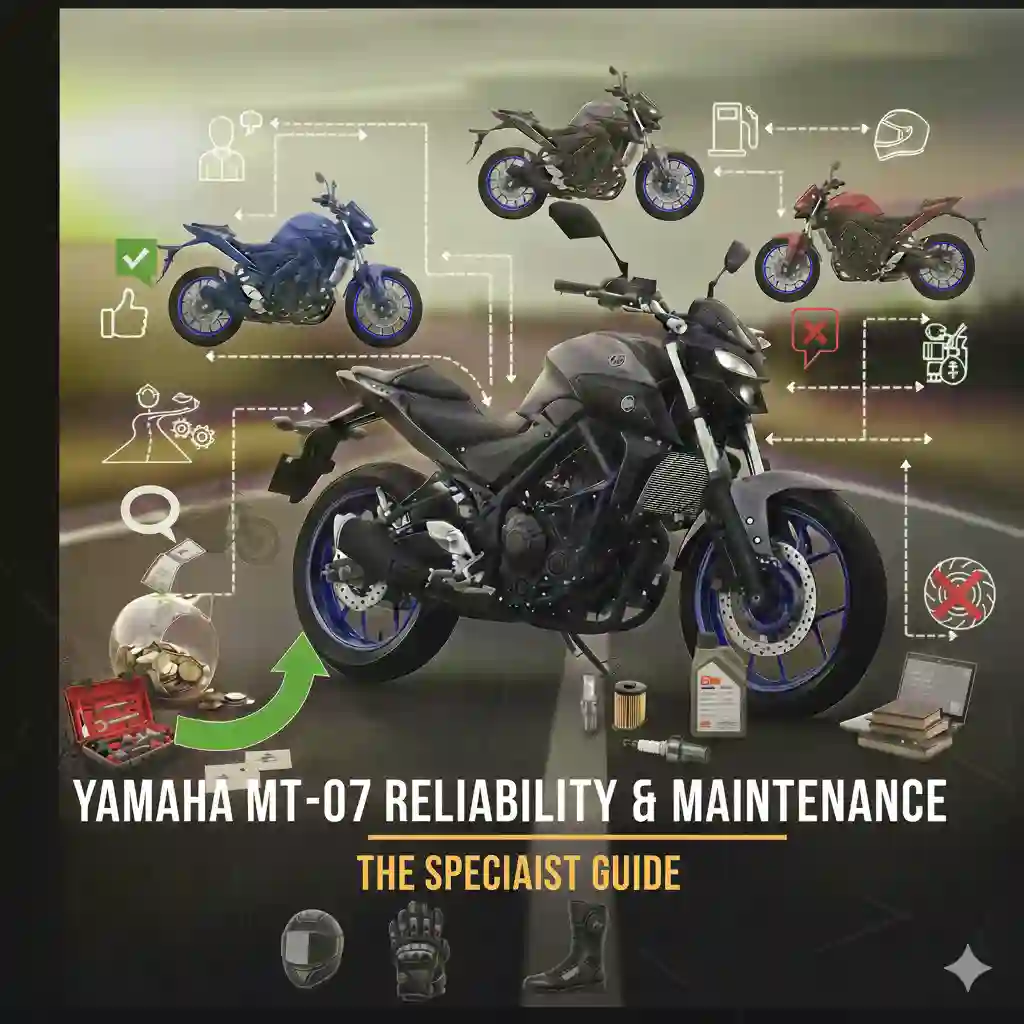
The short answer is yes. The Yamaha MT-07, produced by the Yamaha Motor Company, is widely regarded as one of the most reliable motorcycles in the modern middleweight category.
Its reputation is built on three pillars:
- The CP2 Engine: A mechanically simple, under-stressed parallel-twin platform that has proven bulletproof across multiple Yamaha models (including the Ténéré 700 and XSR700).
- Simplicity: It lacks the complex variable valve timing, extensive sensor arrays, or intricate electronic suspension found on more expensive European rivals. Fewer parts mean fewer points of failure.
- Manufacturing Quality: Yamaha’s consistent quality control ensures that electrical gremlins and assembly defects are rare.
However, reliability is not a guarantee; it is a result. A neglected MT-07 will fail just like any other machine. Its longevity depends entirely on consistent maintenance.
The CP2 Engine: A Study in Durability
The heart of the MT-07 is the 689cc CP2 (Crossplane Concept 2) parallel-twin engine. From an engineering standpoint, this engine is designed for longevity.
Unlike high-strung supersport engines that scream to 15,000 RPM and require frequent rebuilds, the CP2 puts out its best power in the low-to-mid RPM range. This means the internal components—pistons, rings, and bearings—are subjected to less stress during normal riding.
The cooling system is efficient, the oil passages are well-designed, and the transmission is robust. It is not uncommon to see MT-07s with over 50,000 or even 75,000 miles still running with excellent compression, provided they have received regular oil changes.
Service Intervals & Routine Maintenance
Owning an MT-07 does not require a degree in mechanical engineering. The maintenance schedule is predictable and manageable for the average DIY mechanic or local shop.
Oil & Filter
Regular oil changes are the lifeblood of the CP2 engine. Most owners prefer to change the oil every 3,000 to 4,000 miles (or annually), regardless of the official manual’s potentially longer intervals. Using high-quality full synthetic motorcycle oil ensures the clutch and transmission remain smooth.
Valve Clearance Checks
The major service interval for valve clearance checks is typically around 26,600 miles. This is a significant advantage over some competitors that require valve checks every 15,000 miles. It lowers the cost of ownership significantly during the first few years of riding.
Chain & Drive System
As a torque-heavy bike, the MT-07 can be hard on chains if the rider is aggressive.
- Clean and Lube: Every 300–500 miles.
- Tension Check: Every 600 miles.
The torque “pulse” of the crossplane engine can stretch cheap chains quickly. Investing in a high-quality X-ring chain is recommended.
Coolant & Fluids
Brake fluid and coolant should typically be flushed every two years. The braking system is standard (non-linked on older models), making bleeding brakes a straightforward 20-minute job in your garage.
Real-World Maintenance Costs
What does it actually cost to keep an MT-07 on the road? Compared to the broader market, costs are generally low to moderate.
- Tires: This is likely your biggest recurring expense. Because the bike is light but torquey, it can scrub rear tires quickly if you ride aggressively. Expect to replace the rear tire every 4,000–8,000 miles depending on compound and riding style.
- Brake Pads: The MT-07 is light, which reduces wear on brake pads compared to heavier touring bikes.
- Fuel: The bike is efficient, often returning 50+ MPG, which keeps daily running costs down.
Unlike European competitors that might require specialized diagnostic tools to reset service lights, the MT-07 is largely analog in its maintenance needs.
Common Yamaha MT-07 Problems (The Honest Truth)
No bike is perfect. While mechanical failures are rare, there are known “characteristics” and minor issues that long-term owners discuss.
1. Soft Suspension
This is not a reliability “failure,” but it is the most common owner complaint. The stock shock and fork springs are soft and can degrade over time, leading to a bouncy ride. Many owners treat suspension upgrades as a necessary maintenance item after 10,000 miles.
2. Surface Corrosion
On bikes kept outdoors or ridden on salted roads, the swingarm and certain fasteners can be prone to surface rust. This is cosmetic but requires vigilance with anti-corrosion sprays (like ACF-50) if you ride in winter.
3. “Notchy” Shifting
Some riders report the gearbox feeling clunky or notchy, particularly between 1st and 2nd gear. This is often solved by switching to high-quality synthetic oil or adjusting the chain tension and clutch cable free-play.
4. Headlight Vibration
On early first-generation models, some owners reported a rattling headlight assembly. This is usually fixed with simple DIY damping methods (rubber washers or foam tape).
Electrical & Electronics Reliability
The beauty of the MT-07 lies in its lack of complexity.
- ABS: The ABS module is reliable and rarely fails.
- LCD/TFT Dash: The displays are durable and resistant to water ingress, though screens can fade if left in direct desert sun for years (a common issue for all LCDs).
- Switchgear: The buttons and switches are standard Yamaha parts used on millions of bikes. They are robust, though the starter switch can occasionally get sticky with grime after high mileage.
Cooling System & Heat Management
The liquid-cooling system on the MT-07 is efficient. In stop-and-go city traffic, the fan will kick on regularly. This is normal operation, not overheating.
The engine sheds heat well, and because it is a naked bike, that heat dissipates quickly rather than getting trapped behind fairings. Unless the radiator is clogged with mud or the coolant is old, overheating is extremely rare.
High-Mileage Inspection Checklist (Buying Used)
If you are looking at a used MT-07 with 20,000+ miles, here is what to inspect:
- Chain & Sprockets: Look for “kinked” links or hooked teeth on the rear sprocket. This indicates neglect.
- Valve Service History: If the bike is near 26,000 miles, ask for proof of the valve clearance check. If it hasn’t been done, factor that cost (approx. $500–$800) into your offer.
- Steering Head Bearings: Put the bike on a stand (or center it) and check for a “notch” in the steering when turning the bars. Wheelies can wear these bearings out prematurely.
- Brake Rotors: Check for a lip on the edge of the front discs.
- Exhaust Header Rust: Surface rust on the headers is normal, but deep pitting can be an issue.
Is the MT-07 Expensive to Own?
Compared to its peers, no.
- Vs. European Middleweights (e.g., KTM, Ducati, Triumph): The MT-07 is significantly cheaper to maintain. Parts are less expensive, labor times are shorter due to simplicity, and intervals are generally longer.
- Vs. Other Japanese Bikes (e.g., SV650, Z650): Costs are very similar. The Japanese “Big Four” (Yamaha, Honda, Kawasaki, Suzuki) all offer excellent value in this segment.
Reliability Snapshot
| Category | Rating | Notes |
|---|---|---|
| Engine Reliability | High | The CP2 is virtually bulletproof. |
| Electronics | High | Simple systems mean fewer failures. |
| Maintenance Cost | Low/Moderate | Standard intervals, affordable parts. |
| Parts Availability | High | easy to find OEM and aftermarket parts globally. |
| Overall Durability | High | Built to last with basic care. |
Frequently Asked Questions
1. Is the MT-07 reliable long term?
Yes. High-mileage examples are common. The engine is robust and under-stressed.
2. What are the most common MT-07 problems?
Soft suspension, surface rust on swingarms (if neglected), and occasionally “notchy” shifting are the most cited issues.
3. Is the CP2 engine dependable?
It is arguably one of the most dependable motorcycle engines currently in production, used in multiple Yamaha platforms including adventure bikes.
4. Is the MT-07 expensive to maintain?
No. It is one of the most affordable middleweight bikes to own due to simple mechanics and long valve service intervals.
5. How often does it need servicing?
Oil changes are recommended every 4,000 miles or annually. Chain maintenance should happen every 500 miles.
6. Does the MT-07 overheat?
No. The cooling system is effective. The fan will run often in traffic, which is normal.
7. Is the MT-07 good for high mileage riding?
Mechanically, yes. Ergonomically, you may want a better seat and windscreen for long distances.
8. Are parts easy to find?
Yes. Because the MT-07 is a global best-seller, OEM and aftermarket parts are available at almost any motorcycle shop.
9. When is the major service interval?
The valve clearance check is at 26,600 miles. This is the most expensive scheduled service.
10. Do I need to use Yamaha branded oil?
No, as long as you use high-quality motorcycle-specific oil (JASO MA/MA2 rated) of the correct viscosity (usually 10W-40).
11. Is the paint quality good?
It is decent for the price point, though the tank plastics can scratch easily. Tank pads are a recommended accessory.
12. Does the MT-07 burn oil?
It is rare for the CP2 engine to consume significant oil between changes unless it has been abused or has very high mileage.
13. How long do the tires last?
Expect 4,000 to 8,000 miles for a rear tire, depending on how much torque you use. Front tires typically last longer.
14. Is the clutch durable?
Yes, the clutch is robust. Premature wear usually comes from rider abuse (excessive slipping or wheelies).
15. Can I do the maintenance myself?
Yes. The MT-07 is a “naked” bike, meaning everything is exposed and accessible. It is an excellent bike for learning DIY maintenance.
Final Verdict
The Yamaha MT-07’s reputation for reliability is well-earned. It comes from a combination of mechanical simplicity, smart engineering, and the proven durability of the CP2 engine platform.
It is not a bike that requires constant pampering or specialized diagnostic computers. It asks only for the basics: fresh oil, a clean chain, and routine inspections. In return, it offers one of the most dependable and cost-effective ownership experiences in the motorcycling world. Treat it with respect, and it will run for years.


