Yamaha MT-09 vs Competitors – Complete Comparison Hub
Choosing a middleweight naked bike is no longer just about picking a color or a brand loyalty. The segment has exploded into a diverse battlefield of engineering philosophies. You have torque-rich twins, screaming inline-fours, precision-focused European triples, and the unique crossplane-crank triple that powers the Yamaha MT-09.
This guide is not a shallow spec-sheet comparison. We aren’t here to tell you which bike has two more horsepower at 11,000 rpm. Instead, we are analyzing the character, the engineering intent, and the real-world riding experience of the Yamaha MT-09 against its fiercest rivals. Whether you are upgrading from a beginner bike or looking for a dedicated canyon carver, this hub will help you understand where the MT-09 sits in the landscape of performance naked motorcycles.
The Fast Answer: Where the MT-09 Sits in Its Class
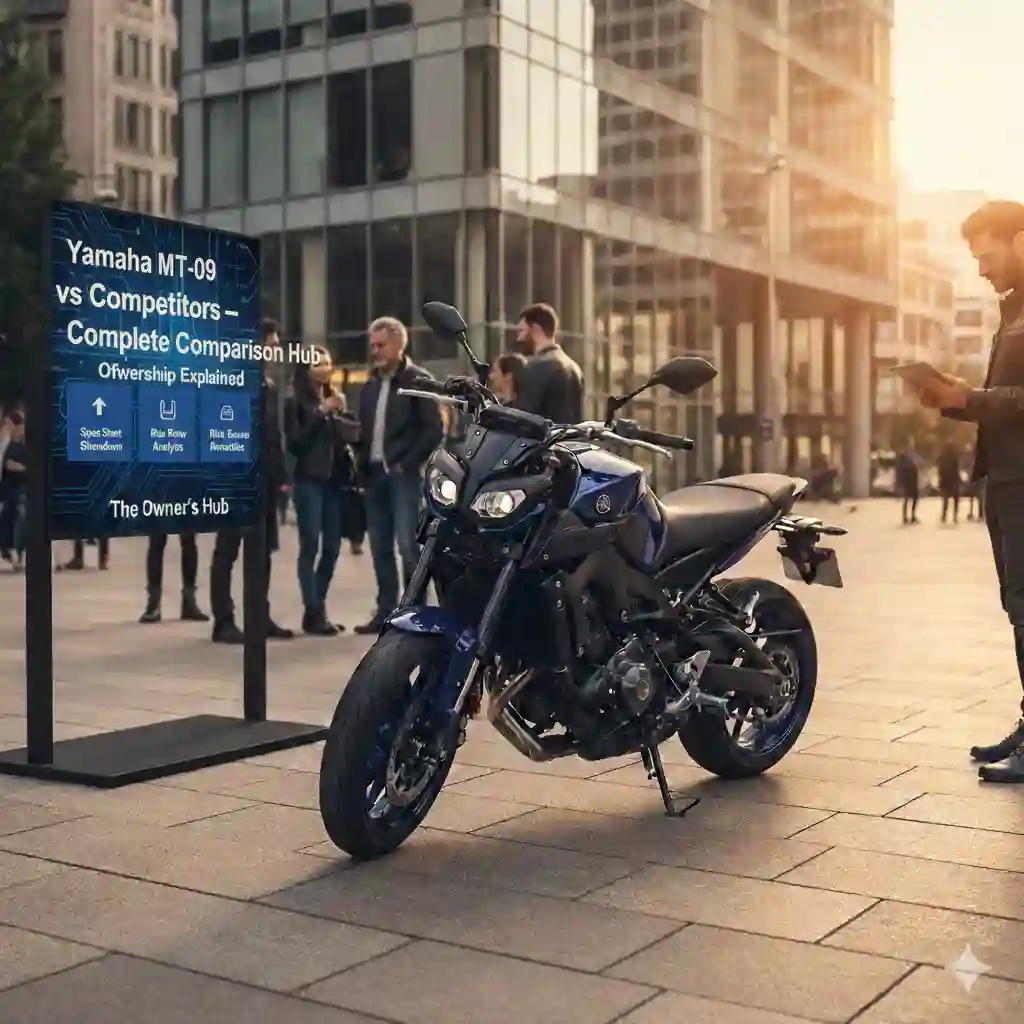
The Yamaha MT-09 occupies a very specific aggressive middle ground in the naked bike segment. It is often described as the “torque master” of the class, prioritizing immediate acceleration and front-wheel-lifting fun over top-end speed or clinical precision.
It sits significantly above entry-level naked bikes like the MT-07 or SV650 in terms of power, electronics, and suspension sophistication. However, it remains distinct from the premium European options like the Ducati Monster or Triumph Street Triple RS, often trading some chassis refinement for raw, rowdy engine character.
If the class were a spectrum, the MT-09 would sit firmly on the “hooligan” side. It is less polite than a Honda, less clinically precise than a Triumph, but arguably more engaging at legal street speeds than almost anything else. It demands a rider who respects throttle response and understands weight transfer. It is a machine built for riders who value the sensation of acceleration above all else.
Yamaha MT-09 vs Yamaha MT-07: The Family Feud
For many riders, the most logical question is whether to buy the Yamaha MT-07 or make the jump straight to the MT-09. While they share a brand and visual DNA, they are fundamentally different machines designed for different stages of a rider’s journey.
Engineering Philosophy
The Yamaha MT-07 uses a 689cc parallel-twin engine (CP2). It is famous for its punchy low-end and approachability. It runs out of breath at high RPMs but offers a friendly, usable powerband that builds confidence. The chassis is basic, with non-adjustable forks (on most models) and a soft rear shock designed for comfort and commuting.
The MT-09 uses an 889cc inline-three engine (CP3). This adds a third cylinder, significantly more power (nearly 45 horsepower more), and a completely different firing order. The CP3 engine retains the low-end torque of a twin but revs out with the ferocity of a four-cylinder. The chassis is stiffer, the suspension is fully adjustable, and the brakes are radial-mount sportbike hardware.
The Skill Gap
The MT-07 is forgiving. You can grab a handful of throttle mid-corner, and while it might unsettle the bike, it likely won’t spit you off. It is an ideal first “big bike.”
The MT-09 is not forgiving of clumsy inputs. Its throttle response is sharp, and the torque hits instantly. A ham-fisted input on an MT-09 can result in an unintentional wheelie or a loss of traction. It requires a rider who understands throttle control and body positioning.
Who Should Buy Which?
- Yamaha MT-07: The perfect choice for newer riders, urban commuters who want great fuel economy, or those who want a fun, stress-free ride without managing advanced electronics.
- Yamaha MT-09: The clear upgrade path. This is for the rider who has mastered the basics and wants a rush of adrenaline. It is for the experienced rider who finds the MT-07’s suspension too soft and its top-end power lacking.
Yamaha MT-09 vs Kawasaki Z900: Triple vs Inline-Four
This is the classic battle of philosophies: the rowdy triple against the smooth inline-four. The Kawasaki Z900 is often the closest competitor in terms of Japanese reliability and target audience, but the riding experience is polar opposite.
Engine Character
The Kawasaki Z900 uses a traditional 948cc inline-four engine. This layout is inherently balanced and smooth. The power delivery is linear—it builds progressively as revs rise. It is docile at low RPMs, making it very easy to ride in traffic, but it screams at the top end. It feels refined, predictable, and incredibly fast in a straight line.
The Yamaha MT-09 feels more urgent. Because of the triple-cylinder layout, it makes its torque much earlier. Where the Z900 builds speed like a jet taking off, the MT-09 feels like being shot out of a cannon. The MT-09 vibrates more, growls louder, and feels more “alive” beneath you.
Handling and Electronics
The Z900 feels planted and substantial. It is heavier than the MT-09, and you feel that weight in a reassuring way. It holds a line in a corner with stability that inspires confidence. However, its electronics suite is generally less sophisticated than the modern MT-09’s IMU-based system.
The MT-09 feels like a bicycle with a rocket engine. It is lighter and possesses more aggressive geometry (steeper rake, shorter wheelbase). It flicks into corners faster but can feel twitchier over bumps. The MT-09’s electronics (slide control, lift control) are more advanced, designed to manage its chaotic nature.
Who Should Buy Which?
- Kawasaki Z900: For the rider who values smoothness, stability, and the classic scream of an inline-four. It is a better highway bike and feels more substantial.
- Yamaha MT-09: For the rider who wants character. If you prefer wheelies to top speed, and agility to stability, the MT-09 is the winner.
Yamaha MT-09 vs Triumph Street Triple 765: Raw vs Refined
If the MT-09 is a sledgehammer, the Triumph Street Triple 765 is a scalpel. Both use inline-three engines, but they approach the “triple” concept from different angles.
Precision vs aggression
The Triumph Street Triple 765 is widely regarded as the handling benchmark of the class. It feels derived from a race bike (Daytona). The chassis is incredibly rigid, the suspension (especially on RS models) is top-tier track quality, and the braking feel is telepathic. The engine is smoother and revs higher than the MT-09, focusing on top-end rush and track performance.
The Yamaha MT-09 is a street brawler. Its engine has a longer stroke, giving it more bottom-end grunt than the Triumph. However, the MT-09’s chassis has historically been looser. While the newest generation is much stiffer, it still prioritizes comfort and agility over the laser-like focus of the Triumph. On a bumpy backroad, the MT-09’s softer setup might be more compliant, but on smooth tarmac, the Triumph is in a league of its own.
Electronics and Positioning
Both bikes feature high-end electronics, including quickshifters and ride modes. However, Triumph’s implementation often feels more refined and less intrusive. The Yamaha system is excellent but can feel more like a safety net for a wild bike, whereas the Triumph system feels like a performance enhancer for a precise bike.
Who Should Buy Which?
- Triumph Street Triple 765: The track-day enthusiast or the rider who appreciates engineering perfection. If you obsess over suspension settings and corner speed, this is your bike.
- Yamaha MT-09: The street rider. If you spend 100% of your time on public roads and want an engine that feels punchy at stoplights and legal speeds, the MT-09’s extra displacement and torque bias make it a riot.
Yamaha MT-09 vs KTM 890 Duke: The Battle for the Canyons
These are the two true “hooligans” of the sector. The KTM 890 Duke (often called “The Scalpel”) and the MT-09 are both marketed on their agility and aggressive nature.
Austrian Sharpness vs Japanese Character
The KTM 890 Duke uses a parallel-twin engine, but unlike the MT-07, it is tuned for high performance. It is incredibly light and features geometry that makes it turn faster than almost anything else on the road. The KTM feels razor-sharp, stiff, and focused. Its electronics are arguably the best in the business, offering granular control over slip and wheelies.
The Yamaha MT-09 feels physically larger and slightly heavier than the Duke, though still light for the class. The CP3 engine is smoother than KTM’s thumping twin and offers a more elastic powerband. The Yamaha feels more substantial, whereas the KTM feels like a supermoto on steroids.
Reliability and Ownership
This is the elephant in the room. Yamaha has a legendary reputation for bulletproof reliability. The CP3 engine is known to rack up high mileage with basic maintenance. KTM, while offering incredible performance, often requires more attentive ownership and has a reputation for more frequent electrical or mechanical quirks.
Who Should Buy Which?
- KTM 890 Duke: The hardcore rider who wants the absolute sharpest tool in the shed and doesn’t mind potentially higher maintenance requirements.
- Yamaha MT-09: The rider who wants 90% of the KTM’s agility with 100% of Japanese reliability. It’s the safer bet for a daily rider that still wants to scare themselves on the weekend.
Yamaha MT-09 vs Yamaha MT-10: Sibling Rivalry
Is bigger always better? The Yamaha MT-10 is the flagship of the range, based on the YZF-R1 superbike. It sits a class above the MT-09, but the comparison is valid for riders with the budget to upgrade.
Middleweight vs Liter-Class
The Yamaha MT-10 uses a 998cc inline-four crossplane engine (CP4). It produces significantly more power (around 160hp vs 117hp) and torque. It is a heavier, physically larger machine with a chassis derived from a superbike. It feels planted, stable, and incredibly fast. However, it drinks fuel at an alarming rate and can feel bulky in tight city traffic.
The Yamaha MT-09 feels like a toy compared to the MT-10. It is lighter, narrower, and easier to flick around at low speeds. The power difference is noticeable on a highway or track, but on a twisting canyon road, a skilled rider on an MT-09 can easily keep up with an MT-10 because of the agility advantage.
Manageability
The MT-10 is a serious machine that demands respect at all times. The MT-09, while powerful, is less physically demanding to ride. The clutch is lighter, the bike is narrower between the knees, and the heat management is generally better for urban riding.
Who Should Buy Which?
- Yamaha MT-10: The rider who wants superbike performance without the clip-on handlebars. It is for wide-open spaces, highways, and track days.
- Yamaha MT-09: The rider who values the “fun factor” over ultimate speed. It is a better balanced motorcycle for the reality of daily riding.
Segment Comparison Table
| Feature | Yamaha MT-09 | MT-07 | Kawasaki Z900 | Triumph Street Triple | KTM 890 Duke |
|---|---|---|---|---|---|
| Engine Type | Inline-3 (CP3) | Parallel-Twin | Inline-4 | Inline-3 | Parallel-Twin |
| Torque Feel | Aggressive, Instant | Punchy Low-End | Linear, Smooth | Linear, Rev-Happy | Punchy, Sharp |
| Agility | Very High | High | Moderate/Stable | Extremely High | Extremely High |
| Electronics | Advanced (IMU) | Basic | Moderate | Advanced | Advanced |
| Suspension | Fully Adjustable | Basic | Adjustable | High-Spec (Fully Adj) | Adjustable |
| Rider Skill | Intermediate/Exp | Beginner/Int | Intermediate | Intermediate/Exp | Experienced |
| Best For | Thrill Seekers | Urban/New Riders | Smooth Touring/Sport | Precision/Track | Canyon Carving |
Which Bike Is Best for Which Rider?
Understanding specs is one thing; understanding yourself is another. Here is a breakdown of which bike fits your rider profile.
The New Intermediate Rider
- Profile: You have ridden a 300cc or 400cc bike for a year or two. You want more power but are intimidated by “beast” marketing.
- Best Bike: Kawasaki Z900 or Yamaha MT-07. The Z900’s smooth power delivery is easier to manage than the MT-09’s snatchy torque, and the MT-07 is the logical next step. The MT-09 is manageable in low power modes, but it invites trouble.
The Experienced Street Rider
- Profile: You’ve been riding for years. You don’t care about track times; you care about having fun on the ride to work or the Sunday blast.
- Best Bike: Yamaha MT-09. It offers the highest “smiles per mile.” The engine character makes even boring roads fun.
The Track-Focused Rider
- Profile: You spend your weekends at the track or ride the canyons with a focus on perfecting your lines and body position.
- Best Bike: Triumph Street Triple 765 or KTM 890 Duke. The chassis precision on these bikes rewards technical riding in a way the MT-09 does not.
The Commuter with a Wild Side
- Profile: You ride to work every day, rain or shine, but you want to take the long way home. Reliability is key.
- Best Bike: Yamaha MT-09. It is reliable enough for daily duty, comfortable enough for traffic, but wild enough to make the commute interesting.
Performance vs. Refinement Spectrum
To visualize where these bikes land, imagine a scale. On the left, we have Refinement—smoothness, stability, predictability. On the right, we have Raw Character—vibration, instant torque, agility.
- Far Left (Refinement): Kawasaki Z900. It is the Honda Accord of the group (in a good way)—smooth, powerful, reliable, predictable.
- Center-Left: Triumph Street Triple. Extremely refined engineering, but with a sporty edge.
- Center-Right: Yamaha MT-07. Punchy and fun, but lacks the high-end madness.
- Far Right (Raw Character): Yamaha MT-09 and KTM 890 Duke. These bikes vibrate. They lift their front wheels. They want to play. They trade some stability for a feeling of being alive.
The MT-09 sits deeply in the “Character” zone. It is not the bike for someone who wants to forget the machine is there. It is the bike for someone who wants to wrestle with it slightly.
Reliability & Ownership Considerations
When buying a motorcycle, you are also buying into a relationship with the machine’s maintenance schedule.
Japanese Reliability (Yamaha, Kawasaki):
The MT-09 and Z900 benefit from the legendary Japanese manufacturing ethos. Parts are generally cheaper, dealer networks are vast, and the engines are over-engineered. The CP3 engine in the MT-09 has proven to be incredibly durable, often seeing high mileage with no major issues. Electronics on these bikes are generally robust “set and forget” systems.
European Complexity (KTM, Triumph):
While Triumph has made massive strides in reliability, and modern KTMs are far better than their ancestors, there is still a “complexity tax.” Parts can be more expensive and harder to source. Dealer networks are smaller. KTMs, in particular, push the engineering envelope so hard (lightest weight, highest compression) that they can be more sensitive to maintenance intervals and electrical gremlins.
The Electronics Factor:
As bikes get more complex, electronics become a reliability point. The MT-09’s switch to a full ride-by-wire system with a six-axis IMU increases the complexity compared to older models. However, Yamaha’s implementation of these systems has been largely trouble-free compared to some European rivals that struggle with software updates and sensor errors.
Common Buyer Mistakes
We see riders make the same errors in judgment repeatedly when shopping in this segment. Avoid these traps:
- Buying for Peak Horsepower: “The Z900 has 125hp, the MT-09 has 117hp, so the Z900 is faster.” False. In the real world, torque-to-weight ratio wins. The MT-09 is lighter and makes its torque earlier, meaning it often feels faster in 90% of riding scenarios.
- Ignoring the Torque Curve: You don’t ride a dyno sheet. A peaky engine (like a 600cc supersport) feels slow until you break the law. The MT-09’s flat torque curve means you have power now, without downshifting.
- Underestimating Throttle Sensitivity: Many riders buy an MT-09 thinking they can handle it because they rode a dirt bike once. The “A” mode (most aggressive throttle map) on an MT-09 is genuinely twitchy. It can ruin your confidence if you aren’t ready for it.
- Assuming “Adjustable Suspension” Means “Good Suspension”: Just because the MT-09 has adjustable suspension doesn’t mean it’s set up for you. Many riders complain about handling without ever setting their sag or rebound. The Triumph Street Triple RS has better components out of the box, whereas the MT-09 requires setup to shine.
Frequently Asked Questions
1. Is the Yamaha MT-09 faster than the Kawasaki Z900?
In a drag race to top speed, the Z900 will eventually pull ahead due to higher horsepower and better aerodynamics. However, in a 0-60mph sprint or a roll-on acceleration test from 50mph, the MT-09 is often quicker due to its lighter weight and instant torque.
2. Is the Triumph Street Triple more refined than the MT-09?
Yes. The fit and finish, the smoothness of the quickshifter, and the feedback from the chassis are generally superior on the Triumph. The MT-09 feels a bit more industrial and raw.
3. Is the MT-09 too aggressive compared to the MT-07?
For a beginner, yes. The jump in power and throttle response is massive. However, the MT-09 has ride modes. If you put it in the softest mode (Mode 4), it becomes much more docile, essentially mimicking an MT-07’s output, making the transition easier.
4. Which naked bike has the best electronics?
The KTM 890 Duke and the Yamaha MT-09 (Gen 3 and later) are neck-and-neck here. Both use sophisticated 6-axis IMUs. KTM allows for slightly more granular customization of traction control on the fly, but Yamaha’s system is incredibly effective and easier to use.
5. Which one is best for daily use?
The Yamaha MT-09 or Kawasaki Z900. Both have comfortable upright ergonomics. The MT-09 is lighter, making it easier to maneuver in parking lots, but the Z900 is smoother on the highway.
6. Does the MT-09 wheelie too easily?
It wheelies very easily, but modern electronics (Lift Control or LIF) prevent it from flipping over. You can adjust how high the front wheel gets, or turn it off completely if you hate fun.
7. Is the seat height on the MT-09 a problem for short riders?
At 32.5 inches, it is average for the class. However, the seat is narrow at the tank junction, which helps shorter riders reach the ground. The Z900 has a lower seat height (31.3 inches), making it more accessible for shorter riders.
8. Is the vibration on the MT-09 annoying?
It is noticeable, but most riders find it adds character rather than annoyance. It buzzes more than a Z900 but shakes less than a Ducati or KTM twin.
9. Can I tour on an MT-09?
You can, but the lack of wind protection and the relatively small 3.7-gallon tank are limiting factors. You will be stopping for gas every 130-150 miles.
10. Why is the Yamaha MT-09 called “The Master of Torque”?
Marketing speak aside, it refers to the crossplane crank design which aligns composite torque with combustion torque, resulting in a direct connection between throttle and rear tire force. It feels stronger than the numbers suggest.
11. Is the MT-09 good for a passenger?
Not really. The passenger seat is small, flat, and the footpegs are high. The Z900 is slightly better, but none of these naked bikes are designed for two-up comfort.
12. Which bike holds its value better?
Generally, the Yamaha MT-09 and Kawasaki Z900 hold their value very well due to high demand and reliability. European bikes can depreciate faster once out of warranty.
13. Do I need the SP version of the MT-09?
If you are a heavier rider or plan to do track days, the SP version (with Öhlins rear suspension and upgraded forks) is worth the extra money. For average street riding, the standard model is sufficient.
14. Is the MT-09 engine reliable?
Extremely. The CP3 engine is widely considered one of the most reliable motorcycle engines currently in production.
15. How does insurance compare?
The MT-09 can be expensive to insure for young riders because it is classified as a high-performance “hooligan” bike with high accident rates. The MT-07 or Z900 (depending on region) may be slightly cheaper.
Final Verdict – Where the MT-09 Truly Stands
The Yamaha MT-09 occupies a unique middle ground in the motorcycle world. It delivers the aggressive torque and advanced electronics of a premium European machine without the precarious ownership costs. It offers significantly more excitement than the standard Japanese inline-fours without entering the terrifying territory of 200hp liter-bikes.
It is neither the smoothest bike in its class (that’s the Z900) nor the most refined (that’s the Street Triple). But it is arguably the most character-driven.
The MT-09 is a performance naked bike for riders who value personality over perfection. It is for the rider who wants their commute to feel like a video game. If you prioritize a sterile, flawless ride, look elsewhere. But if you want a machine that feels like an accomplice in your fun, the MT-09 stands alone.


